EN
EN 

Turbocharger Repair
Professional hydroabrasive cleaning of turbocharger parts for auto repair shops and workshops specialising in turbocharger reconditioning for passenger and commercial vehicles
Why turbocharger cleaning must be done properly
After disassembly, turbocharger parts are coated with hard-to-remove contaminants: baked-on oil, soot and carbon deposits. This is an unavoidable result of operating under extreme heat and pressure. Poor cleaning leads to assembly defects, accelerated wear and customer complaints.
Traditional methods — manual scrubbing with brushes and solvents, or sandblasting — have serious limitations. Sandblasting damages surfaces, alters tolerances and leaves abrasive particles inside oil passages. Manual cleaning is time-consuming and delivers inconsistent results. That is why leading turbocharger workshops are switching to aquablasting.
What is aquablast and how does it work
Aquablasting (wet blasting or hydroabrasive cleaning) is a process in which a mixture of water and fine abrasive media is delivered under pressure onto the surface being cleaned. Water acts as a lubricant: it cushions the impact of the abrasive, preventing it from damaging the metal, while simultaneously flushing away contaminants.
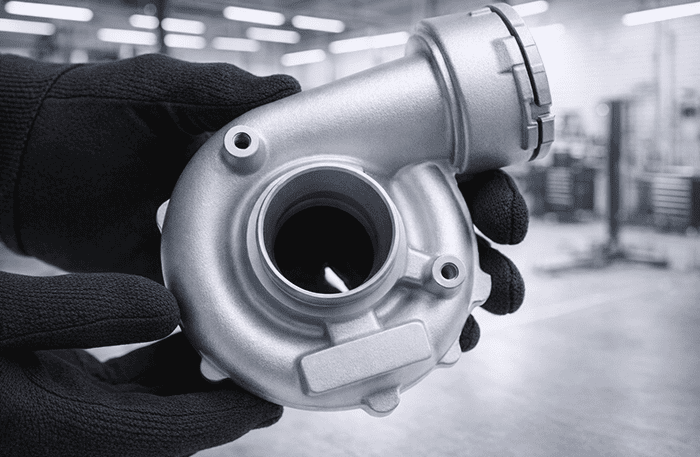
The result is a part cleaned down to bare metal with no loss of dimensions or surface finish. The housing, compressor wheel, shaft and all other turbo components look brand new — literally.
Aquablast vs. sandblasting vs. manual cleaning
|
✔ Aquablast No surface damage. Like-new finish. 5–20 min for a full set. Consistent quality with no manual labour. |
✖ Sandblasting Risk of metal damage. Abrasive remains in oil passages. Alters tolerances. Unsuitable for precision turbo parts. |
✖ Manual cleaning Time-consuming — up to several hours. Inconsistent results. Depends on technician skill. Chemical solvents are hazardous. |
Benefits for auto repair shops and turbocharger workshops
For a workshop specialising in turbocharger reconditioning — for both passenger cars and commercial vehicles — aquablasting becomes a genuine competitive advantage. The processing speed allows more jobs to be taken on: the housing is cleaned in 5 minutes, and a full disassembled set of parts in 15–20 minutes. That is several times faster than any alternative method.
Because aquablasting does not damage metal or alter part geometry, the quality of the subsequent rebuild is significantly higher. The technician does not need to spend time on manual scrubbing — they can focus entirely on diagnostics and assembly.
The customer receives a turbocharger with parts that look brand new. This builds trust, increases the perceived value of the service and supports higher pricing.
Which turbo parts can be cleaned with aquablast
The process is suitable for all major turbocharger components: the compressor and turbine housings, the centre housing rotating assembly (CHRA), the compressor wheel, turbine wheel, end caps and brackets. Aquablasting effectively removes oil deposits, carbon build-up, soot, oxidation products and gasket residue — everything that accumulates during normal service life.
Summary
Aquablasting is the optimal choice for professional turbocharger cleaning. Fast, safe for components and consistently high in quality. If your workshop handles turbocharger reconditioning, aquablast will reduce part preparation time and raise the overall standard of every repair.